
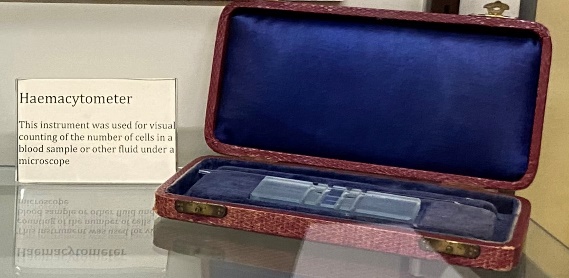
The hemocytometer is a medical counting-chamber device originally designed and usually used for counting blood cells. The hemocytometer was invented by Louis-Charles Malassez in 1874 and consists of a thick glass microscope slide with a rectangular indentation that creates a precision volume chamber. This chamber is engraved with a laser-etched, glass slide grid of perpendicular lines. This grid is further divided into smaller …
Author archives: The Service Battalion Senate, Inc.
Cuff, Blood Pressure, (Sphygmomanometer)

History: In 1881, the first sphygmomanometer (an instrument for measuring blood pressure,) was invented by Samuel Siegfried Karl Ritter von Basch. Scipione Riva-Rocci introduced a more easily used version in 1896 to measure systolic blood pressure. Blood pressure is measured using two numbers. The first number, systolic blood pressure, measures the pressure in blood vessels when one’s …
Arm, Prosthesis

In 1812, a prosthetic arm was developed that could be controlled by the opposite shoulder with connecting straps — somewhat similar to how brakes are controlled on a bike. Well-designed prosthetics deliver functionality and are cosmetically pleasing, but they also serve to complete an amputee’s sense of wholeness. A prosthesis provides mobility as well as emotional comfort. The …
TYPEWRITER, Royal, KMG15
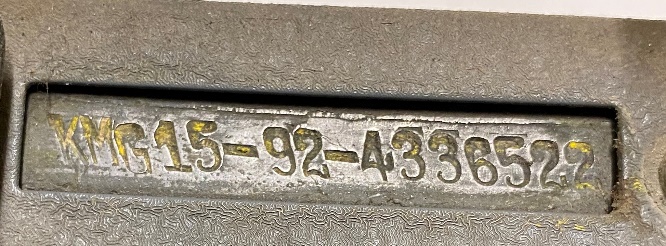
This manual typewriter is vintage 1949 and was made in Canada. Details: The photo shows a Model “kmg” 2/10/49. Paint colour: gray frieze. Dimensions: 12” wide X 14 1/2” deep X 9” high. Weight: 25.5 lbs. The Cyrillic letter key layout originated from America in the late 19th century. The Second World War brought tremendous …
Stereoscope, 3D
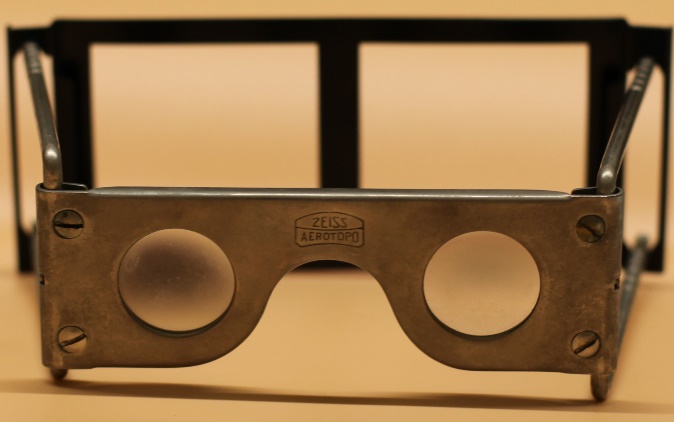
Stereoscopic photography (3D photography) is when two slightly offset photos are combined into one three-dimensional picture. It was a simple Victorian invention which brought the enemy landscape into 3D during the Second World War. In 1830, a man called Sir Charles Wheatstone created an original binocular-type apparatus that later gave impetus to the appearance of the new …
Pins, Lapel, Soviet, Civilian

1.- Red Army of the Soviet Union badge The badge depicts the Spasskaya Tower of the Moscow Kremlin, with Lenin’s Mausoleum in front. The Order of the Red Banner recognized military deeds. 2. – Soviet Young Lenin Badge, Red Star. Made in the USSR in the 1970’s; School Pupils’ Communist Pin Soviet children began school at …
Badges and Pins, Soviet

1 – Soviet Army Excellent Soldier Award Uniform Pin Badge. This is a metal award badge for excellent army service. 2 – USSR forces military award 2nd and 3rd class specialist 1950. Awards and decorations of the Soviet Union are decorations from the former Soviet Union that recognized achievements and personal accomplishments, both military and civilian. Some of …
Recorder, Cutting Lathes
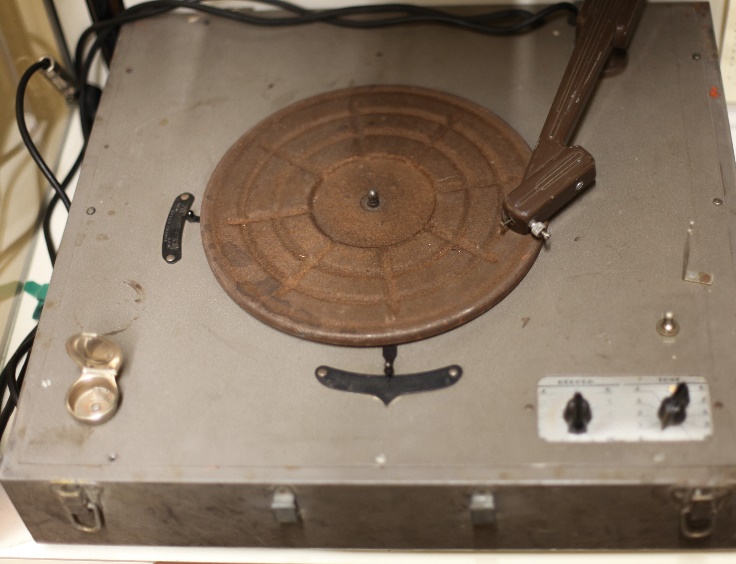
History: During the electrical era (1925–1947) a record converted grooves on a record into sound. The electronics in the cutting lathe do the reverse. They turn the sound waves from the sound into vibrations that the lathe’s stylus cuts into grooves on a (wax) disc (record). Record cutting lathes were made by a variety of …
Kit, Fingerprint
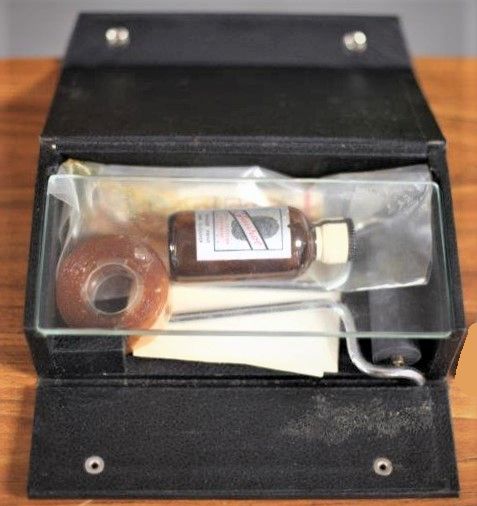
The Chinese were the first culture known to have used friction ridge impressions (friction ridge allows people to grip and to hold on to various surfaces) as a means of identification. The earliest example comes from a Chinese document entitled “The Volume of Crime Scene Investigation—Burglary”, from the Qin Dynasty (221 to 206 B.C.). In …
Device, Numerical Encryption, KAL-61
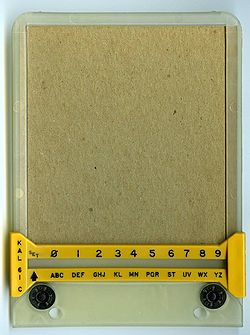
The KAL-61 is a piece of coding/decoding equipment used by the Canadian Military, United States Army and NATO forces for encrypting and authenticating non-secure communications. In Canada, the code used was called ‘CANFOROPS‘. Specifications: The device length is 15.4 cm; its width is 11.2 cm. This device was used to authenticate non-secure communications in the military. An …