

Description: The general list cap badge was a standard badge worn by soldiers of the Canadian Expeditionary Force (CEF) during the First World War. In principle, the general list cap badge distinguished Canadian soldiers from their British counterparts. In practice, however, most Canadian units and formations designed and purchased their own distinctive cap badges. Background: …
Category archives: Museum Artifact
Badges, Unit, Canada, First World War

The 179th (Cameron Highlanders of Canada) Battalion, CEF was a unit in the Canadian Expeditionary Force during the First World War. Based in Winnipeg, Manitoba, the unit began recruiting during the winter of 1915/16 in that city. After sailing to England in October 1916, the battalion was absorbed into the 17th Reserve Battalion on October 21, 1916. The battalion was disbanded on …
Sword and Socket Bayonets

In 1871 the British adopted the Martini-Henry rifle. The Martini-Henry was issued to The Royal Canadian Regiment but was not a general issue to the Militia. The Queen’s Own Rifles and the Royal Grenadiers—the main Toronto-based militia units mobilized for the conflict with Riel Rebellion (Resistance) in Rupert’s Land. The Mark IV Martini–Henry rifle was …
Binoculars

Binoculars are two telescopes attached side-by-side and aligned to focus in the same direction which may also be described as an optical instrument with a lens for each eye that is used for viewing distant objects. They are also known as field glasses which provides a magnified view of distant objects. The British government sought …
Book, Pay, Soldier’s Service

The Active Service Pay Book included this table of pay rates for the information of the officers, NCOs, and soldiers of the CEF. There were occasions for soldiers of the CEF to be paid extra allowances. On 1 November 1915, the Minister of Militia and Defence fixed rates of pay for the Canadian Expeditionary Force. …
Bottle, Water 1918

This is a First World War-style, enamelled, water bottle with cork, housed in a felt carrier with a sling. In early 2WW, the great pressure for military supplies prompted the British Army to issue standard water bottles in 1903 pattern skeletal leather carriers. The “bottle” measures 8 inches high by 6 inches wide. Description Blue …
Box, Cigarette, Benson & Hedges (1915)

History: Benson & Hedges was founded in London, England in 1873 by Richard Benson and William Hedges as Benson and Hedges Ltd. In the 1900s they opened branches in the United States and Canada. In 1915, the Army decided to give cigarettes to enlisted men because they wanted to keep them calm during battle and …
Box, Toffee Candy, Earl Kitchener of Khartoum

Halton’s Toffee Tin with Image of Earl Kitchener of Khartoum. Secretary of State for War (of Khartoum). Ridgway’s Tea Caddy with First World War Scenes and | Etsy UK This historic Great War hinged tin box has Earl Kitchener and the Union Flag on the lid. This design is intended for Home Front propaganda and can …
Continue reading “Box, Toffee Candy, Earl Kitchener of Khartoum”
Box, Chocolate, Queen Victoria Gift, 1900
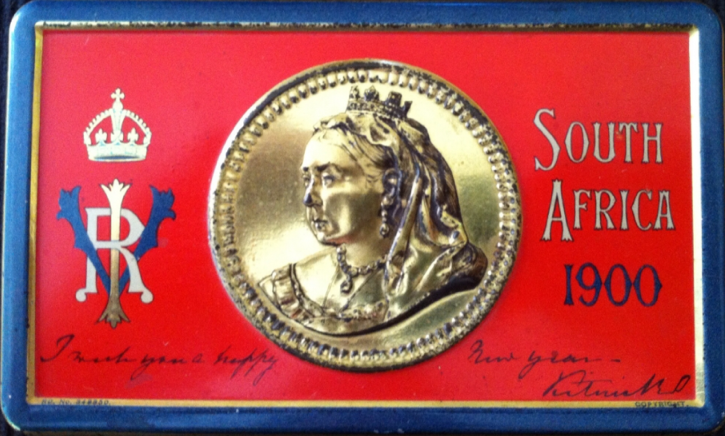
In 1899 Queen Victoria decided to send a gift of tin boxes of chocolate to her troops serving in South Africa. It was intended that every soldier and officer should receive a box with the inscription ‘South Africa 1900’ and in the Queen’s handwriting ‘I wish you a happy New Year’. Description: Rectangular tin with …
Continue reading “Box, Chocolate, Queen Victoria Gift, 1900”
Bugle, Bugle Calls
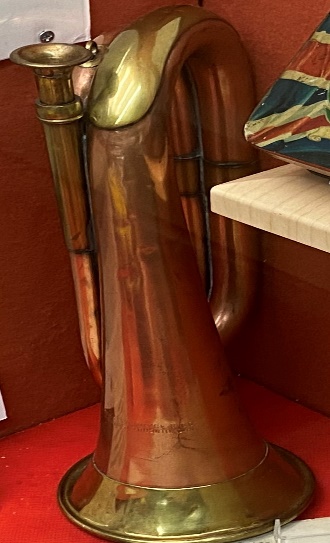
The bugle was used primarily by infantry and cavalry to relay instructions from officers to soldiers during battle. It was also used at large training camps with service support units to coordinate activities. Description: A bugle is usually made of copper, gold, (brass) and silver-coloured metals. Origin: The bugle shown was manufactured by the Whaley …