

This lighter is Swiss made of the highest quality. Thorens was originally a music box maker who began that business in 1883. Their most sought-after lighter models are of the 1920s to 1930s era. The company moved into making record turntables, speakers, and other music items eventually. Their “Standard Original” model lighter was introduced in …
Author archives: The Service Battalion Senate, Inc.
Knuckles, Metal

Sometimes called “brass knuckles, knucks, brass knucks, knucklebusters. Knuckle dusters, an English punch or a classic”, knuckles were weapons used in hand-to-hand combat. The extended and rounded palm grip also spreads across the attacker’s palm to distribute the counter-force that would otherwise be absorbed primarily by the attacker’s fingers, reducing the likelihood of damage to …
Dog, Collar

What is a “collar dog” in the military? In the military, collar badges are worn as lapel badges on formal uniforms and are often called ‘collar dogs’. This section deals with collar dogs worn by enlisted soldiers, rather than Commissioned Officers. The 259th Battalion, Canadian Rifles, CEF (Siberia), was an infantry battalion of the Canadian Expeditionary Force (Siberia) during the Great War. The 259th …
Dress Regulations for the Canadian Militia 1907

A soldier must maintain a professional appearance to show a professional image, pride, and self discipline while maintaining a high standard of deportment to demonstrate their professionalism. The photo shows Dress Regulations for the Canadian Militia dated 1907. Military dress and designs have gone through many changes over the years. For service members and veterans, …
Continue reading “Dress Regulations for the Canadian Militia 1907”
Cards, Post: Voices from Vimy: Manitobans on the Ridge

This is a sample of a Manitoban’s letter (post card) home from Vimy Ridge in the First World War. This post card is from The University of Manitoba archives and special collections. A picture of Frederick D. Baragar and Silver heels Feb. 17, 1917 is on the front. The following is from the back of …
Continue reading “Cards, Post: Voices from Vimy: Manitobans on the Ridge”
Cap, Field Service (“wedge cap”), Royal Flying Corps (RFC) Cap Badge

The Field Service Cap (“wedge cap”) was officially introduced into the Canadian Army in 1939, when the new Battle Dress uniform was introduced. Wedge style caps had been worn by Canadians in the First World War, particularly by aviators (pilots), but its use was never widespread. The original Royal Flying Corps cap badges were manufactured in brass, …
Continue reading “Cap, Field Service (“wedge cap”), Royal Flying Corps (RFC) Cap Badge”
Camp Hughes Manitoba
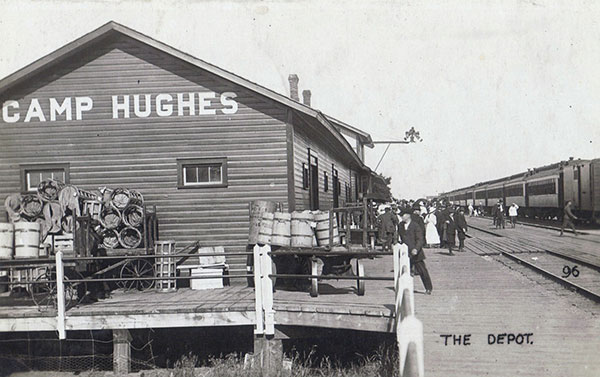
Provincial Heritage Site No. 82, Camp Hughes Military Training Site NE 34-10-16 W, 10 kms west of Carberry, R.M. of North Cypress Established 1909 (used until 1934) National Historic Site of Canada, Designated in 2011 Camp Hughes was a Canadian military training camp. It was actively used for Army training from 1909 to 1934 and …
Buttons, First World War

Buttons, RCD, and Music Branch The Royal Canadian Dragoons (RCD) used 10 different patterns of buttons from 1893 to 2000. The Royal Canadian Dragoons is the most senior cavalry regiment in Canada having been formed on 21 December 1883. The regiment currently serves as a regular force armoured unit in the 4th Canadian Division, 2 …
Bugle, Bugle Calls
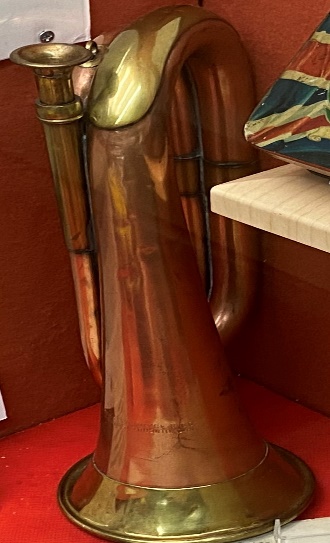
The bugle was used primarily by infantry and cavalry to relay instructions from officers to soldiers during battle. It was also used at large training camps with service support units to coordinate activities. Description: A bugle is usually made of copper, gold, (brass) and silver-coloured metals. Origin: The bugle shown was manufactured by the Whaley …
Box, Chocolate, Queen Victoria Gift, 1900
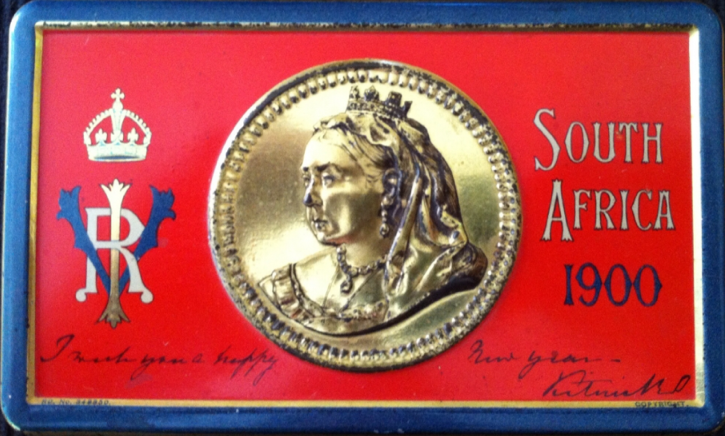
In 1899 Queen Victoria decided to send a gift of tin boxes of chocolate to her troops serving in South Africa. It was intended that every soldier and officer should receive a box with the inscription ‘South Africa 1900’ and in the Queen’s handwriting ‘I wish you a happy New Year’. Description: Rectangular tin with …
Continue reading “Box, Chocolate, Queen Victoria Gift, 1900”