
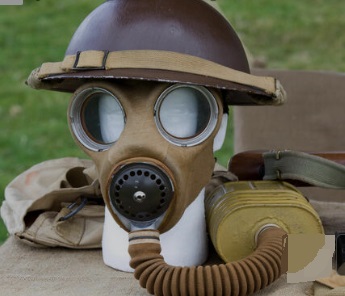
Gas masks were initially not considered an important piece of equipment in the First World War until poison gas attacks by Germany took the Allies on the Western Front by surprise, resulting in many casualties. The British small box respirator was first introduced to British soldiers in April 1916 – a few months before the Battle of the Somme. By …
Author archives: The Service Battalion Senate, Inc.
Powder, Foot – First World War to the Present

The gangrenous condition known as “trench foot” plagued many 1WW soldiers on both sides of the fight. Keeping one’s feet dry became a top priority for every front-line soldier. Foot powder assisted with this task by absorbing moisture away from the skin and helping to clean away debris and reinvigorate the skin. Foot powder was …
Continue reading “Powder, Foot – First World War to the Present”
Badges and Shoulder Flashes of Various Units
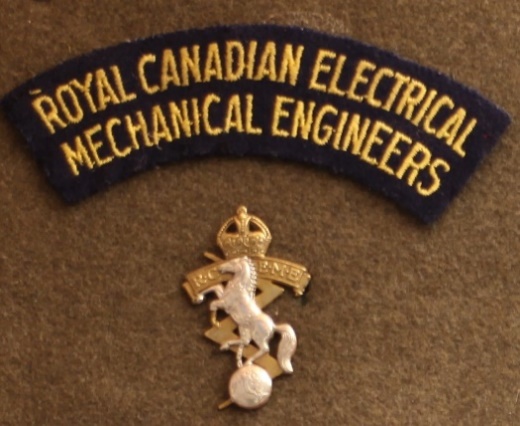
The Royal Canadian Electrical and Mechanical Engineers came into being officially on 15 May 1944, with the fusion of various elements from the Royal Canadian Engineers, Royal Canadian Army Service Corps and Royal Canadian Ordnance Corps, following the model of the Royal Electrical and Mechanical Engineers. With the passing of the 1855 Militia Act, volunteer …
Continue reading “Badges and Shoulder Flashes of Various Units”
Eyeglasses, Combat

Gas masks posed a dilemma for soldiers wearing eyeglasses. The first gas masks were essentially flannel bags with mica lenses. The fit over glasses was often a problem. In addition, glasses tended to fog underneath these hoods. The soldier had the choice between fighting blind or being gassed. Fortunately, early in the Great War, conscripts …
Cup, Tin, Drinking, Green

The Government of India produced these mugs during the Second World War and possibly earlier. This example is made in green enamel by Bengal Enamel in May of 1944. Note the soldered seam along the handle as well as the raised rim on the base. In the field most soldiers eat ration packs or something …
Compass, Lensatic

The compass is a magnetometer (used for measuring the Earth’s magnetic field), for navigation and orientation that shows direction. The structure of a compass consists of the compass rose, which displays the four main directions on it: East (E), South (S), West (W) and North (N). The angle increases in the clockwise position. North corresponds to 0°, so east is 90°, south is 180° and west is 270°. The history …
Compass, Fly-Button, Second World War (RAF – 1940s)
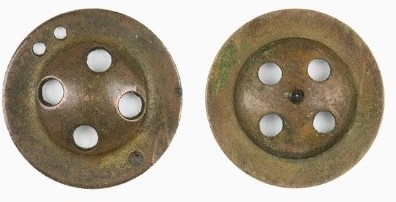
During the Second World War, escape compasses were an important piece of equipment developed by MI9, MI9 was a section of the British Military Intelligence that developed tools to assist with escape and evasion. These compasses were produced in a vast variety and issued as part of escape kits, hidden in uniforms, in buttons or …
Continue reading “Compass, Fly-Button, Second World War (RAF – 1940s)”
Clicker
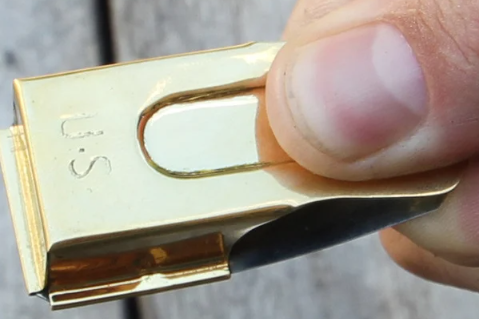
The device, about the size of a person’s thumb, made a metallic clicking sound, and was an essential bit of kit for those landing in Normandy on June 6, 1944, under the cover of darkness. Hollywood actor, John Wayne, helped the clicker become widely known from his dialogue in the 1962 film The Longest Day. …
Brush, Clothes
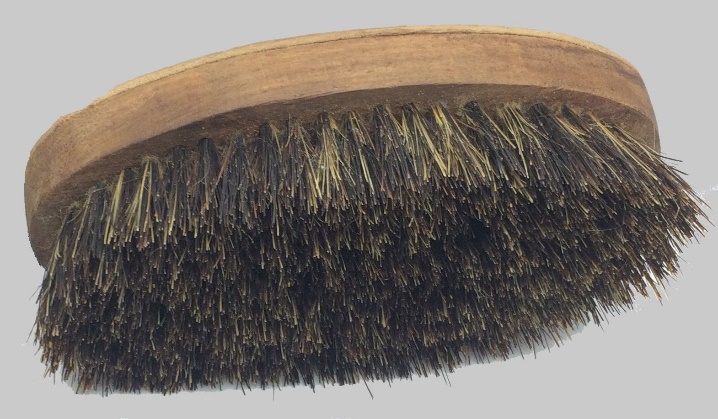
The absence of any residual shoe polish (boot polish) or other leather type dressing suggests this brush may have been used for lint and dust removal from uniforms. This brush type was likely used by an officer or aide to a Commissioned Officer to maintain the appearance of tunics, trousers etc. History: Clothes brushes were …
Medal, 1914-1915 Star

Context: This First World War medal was authorized in December 1918. This medal was always issued with the British War Medal and the Victory Medal. Eligibility and Criteria: The 1914-1915 Star was awarded to all who saw service in any theatre of war against the central (axis) powers between 5 August 1914 and 31 December …