
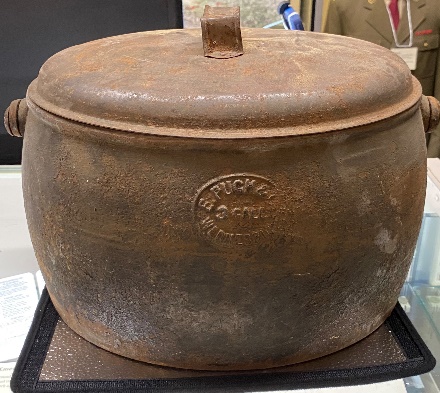
The manufacturers of this cast iron hollowware were E. Pugh & Co., Wednesbury. (Wednesbury is a market town in Sandwell in the county of West Midlands, England) Cast Iron Hollowware, a commercial alloy of iron, carbon, and silicon, the combination is heated to a molten liquid then emptied into a mold (shaped container). Hollowware vessels …
Category archives: Museum Artifact
Pack, Individual Meal (IMP), Canadian Armed Forces
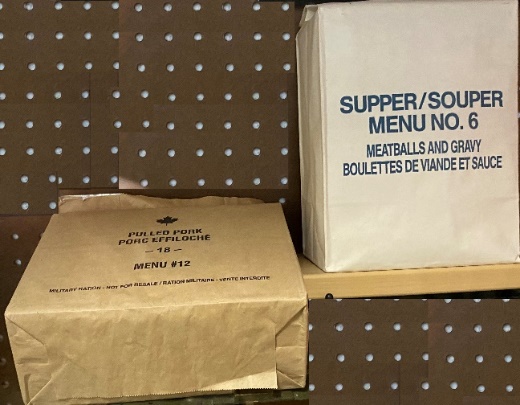
Purpose: The IMP’s purpose is to sustain the nourishment needs of military personnel for one meal a day. It is easy to heat, consumable without heating, resistant to damage during transportation, but not expected to be used for more than 30 consecutive days. Preparation and cooking: For IMPs from 2019 and beforehand, the main entrée and the …
Continue reading “Pack, Individual Meal (IMP), Canadian Armed Forces”
Opener, Can, P-38
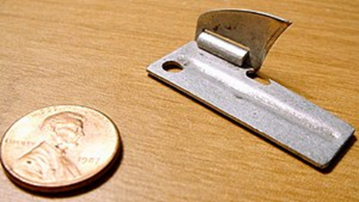
The penny pocket can opener was a well-known and useful piece of GI gear during the Second World War. Far down on the list of important inventions essential to victory in the Second World War is a modest gadget built of stamped metal called the GI Pocket Can Opener—commonly known as the P-38 can opener. …
Set, Mess, Field, Officers’
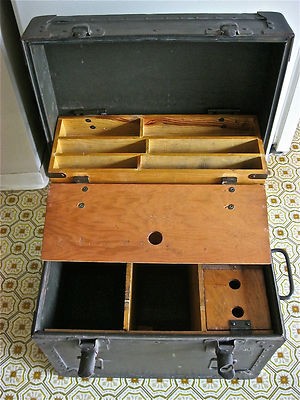
This is an example of a 2WW Officers’ field trunk mess set. The olive drab trunk was made by Wheary Incorporated, JQ.M. (Jeffersonville Quartermaster) Depot, 2 Mar 1942, as shown on the brass tag on the lid. The trunk measures 18” long by 13 ½ inches wide by 14 inches high. The trunk interior contains …
Kitchen, Field

The Napoleonic adage “an army travels on its stomach” is one of the most basic military principles that causes militaries to succeed or fail in battles and wars. The importance of reasonable food and field fresh rations is paramount to successful military operations. A military “field kitchen” is a kitchen, usually on wheels, used primarily …
Carrier, Hot Ration, P37
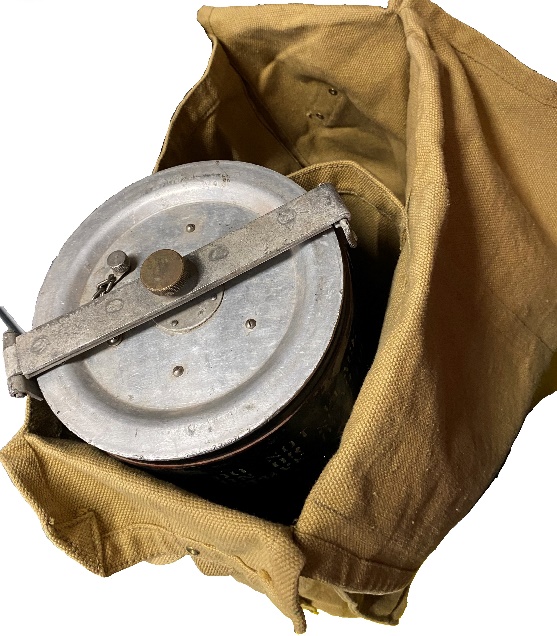
The photo shows a P37 pattern canvas carrying bag with padding and insulation for serving hot meal food rations in the field. During combat situations, when hot rations could not be delivered to men in the field by truck, this pack was used to carry a single (or double) ration canister. The pack is constructed of canvas with fibre …
Container, Storage, Insulated (Haybox)
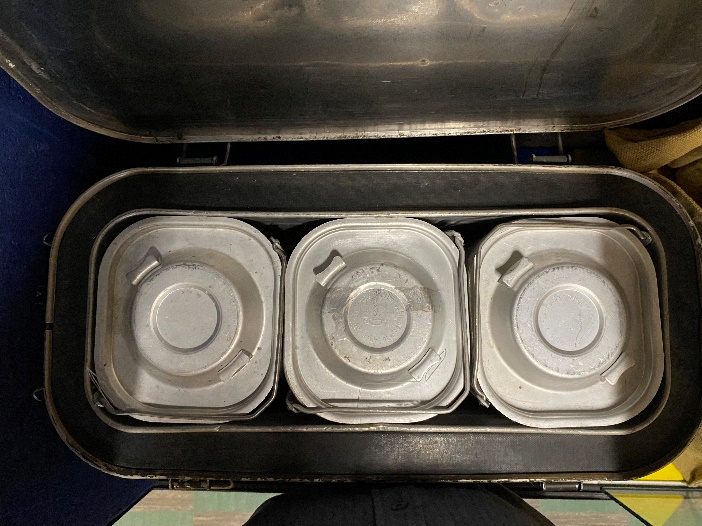
A “haybox” is a cooker that utilizes the heat of the food being cooked to complete the cooking process. Generally, it takes three times the normal cooking time to cook food in a haybox. This highly insulated unit is made for military use to keep food or fluids hot or cold. It’s a very effective …
Bottle, Water and Tins, Mess

The official manual refers to this artifact as a “Canteen Carrier” although the Canadian term “water bottle” is generally considered more appropriate. The water bottle nested into a metal canteen cup which could be used for boiling water to make hot tea, juice crystals, etc. and both were then placed in the carrier. The more …
Wall, Remembrance, Korea Veterans

The Korean Veterans Association of Canada erected a Wall of Remembrance to the 516 Canadians who are commemorated in the Korean War Book of Remembrance. The Wall was dedicated on July 27, 1997 and is located at Brampton, Ontario’s Meadowvale Cemetery. The Korea veterans present for the unveiling marched to the site to pay homage …
Ship, Transport, AP- 43 USS General H.B. Freeman

USS General H. B. Freeman (AP-143) was a General G. O. Squier-class transport ship for the U.S. Navy in World War II. The ship was crewed by the U.S. Coast Guard until decommissioning. She was named in honor of U.S. Army general Henry Blanchard Freeman. She was transferred to the U.S. Army as USAT General H. B. Freeman in 1946. On 1 March 1950 she was again transferred to the Military Sea Transportation …
Continue reading “Ship, Transport, AP- 43 USS General H.B. Freeman”