Document, Japanese Instrument of Surrender, 1945

The Japanese envoys signed the Instrument of Surrender on board the U.S.S. Missouri in Tokyo Bay on September 2, 1945. The document was prepared by the US War Department and approved by President Truman. It set out in eight short paragraphs the complete capitulation of Japan. The second paragraph said: “We hereby proclaim the unconditional …

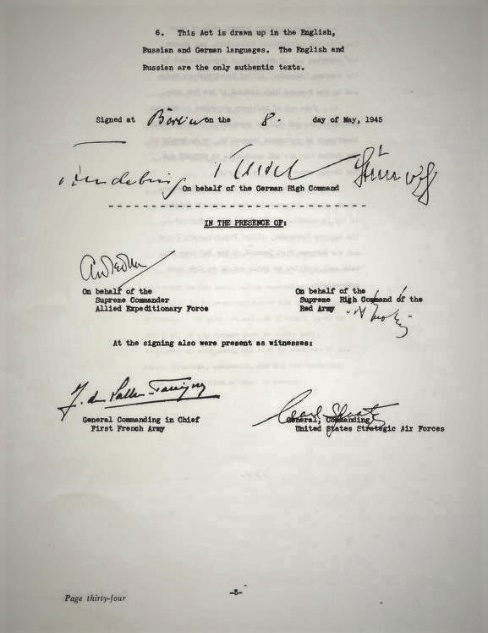
Document, German, Instrument of Surrender

The German Instrument of Surrender was a legal document effecting the unconditional surrender of the armed forces of Nazi Germany to the Allies. It ended the Second World War in Europe. The signing took place at 22:43 Central European Time (CET) on 8 May 1945 and the Germany’s surrender took effect at 23:01 on the same day. The document was signed at the seat of the Soviet …

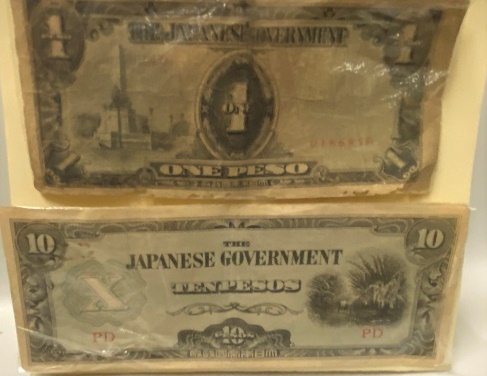
Currency, Japanese Occupation

The Japanese Imperial Army invaded Burma (now Myanmar) in January 1942, conquered Mandalay 21 May 1942, and forced the British to retreat into India. In 1942 the Japanese issued paper scrip currency of 1, 5 and 10 cents and ¼, ½, 1, 5 and 10 Rupees. Japanese military currency was money issued to soldiers of the Imperial Japanese …

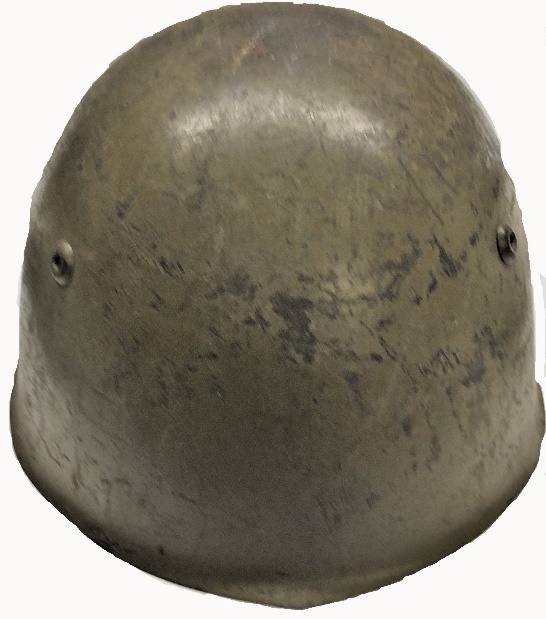
Helmet, Turtle, Mark II, British/Canadian Army

Description: This is a standard, bowl-shaped, MkII steel helmet, painted olive green. Internally the helmet features a black oilskin liner made of five tongues (see 2nd picture inside of liner) with a rubber pad to the crown. There is a khaki coloured canvas web chinstrap fitted. In 1938, the Canadian War Office began production of …

Helmet, CG634, Kevlar

The CG634 is the Canadian Armed Forces’ main combat helmet. It was introduced in 1997 and is based on the French Gallet TC-3 helmet. The helmet has protection Level 3a rating, which means it is able to stop a shot from a .357 Magnum. History: The Canadian military sought a replacement for the steel M1 …

Helmet, 2WW, M1 (C. 1941)

Roughly 22,000,000 of this M1 helmet were produced during the Second World War. Two main companies produced the majority of the 2WW M1 helmets: McCord Radiator & Manufacturing Co., located in Detroit, Michigan. McCord began production in June 1941 and produced twenty million M1 helmets. (2) Schlueter Manufacturing Co., located in St. Louis, Missouri. Schlueter …

Helmet, Warsaw Pact

The Warsaw Pact was established in 1955 to respond to West Germany’s entry into NATO. German aggression was still a recent memory among the Soviets and East Europeans. The East German Army was probably the best trained and best equipped of the Warsaw Pact powers. Ironically, it was also considered the most reliable yet least …

Boots, Ankle, Garrison

Garrison ankle boots were for day-to-day wear in garrison or on a Canadian Forces base, out of the public eye (a “garrison” is a permanent military installation). In the late twentieth century, when all black, all leather boots were a required part of the Army Combat Uniform, soldiers would have one set of field boots, …

Boots, Garrison, Matterhorn Style

This boot has a high top with smooth leather. It was issued to be used in a Garrison (a permanent military installation). A Matterhorn Style boot is a higher length boot compared to a parade boot. The Garrison Dress boot was similar in general design to the combat boot but more cheaply made and not …

Boots, Combat, Canadian, Mark 3 (1982 to 2000)

Combat boots are military boots designed to be worn by soldiers during combat or combat training, rather than during parades and other ceremonial duties. The Canadian Army adopted a rubber soled combat boot. Boot care was officially to be done with special preservative issued in metal tins rather than boot polish. The combat boot was …

CSS Virtual Museum
Feedback Form

Before you leave, please take a moment to share your feedback on the CSS Virtual Museum.

0
    0
    Your Cart
    Your cart is emptyReturn to Shop